
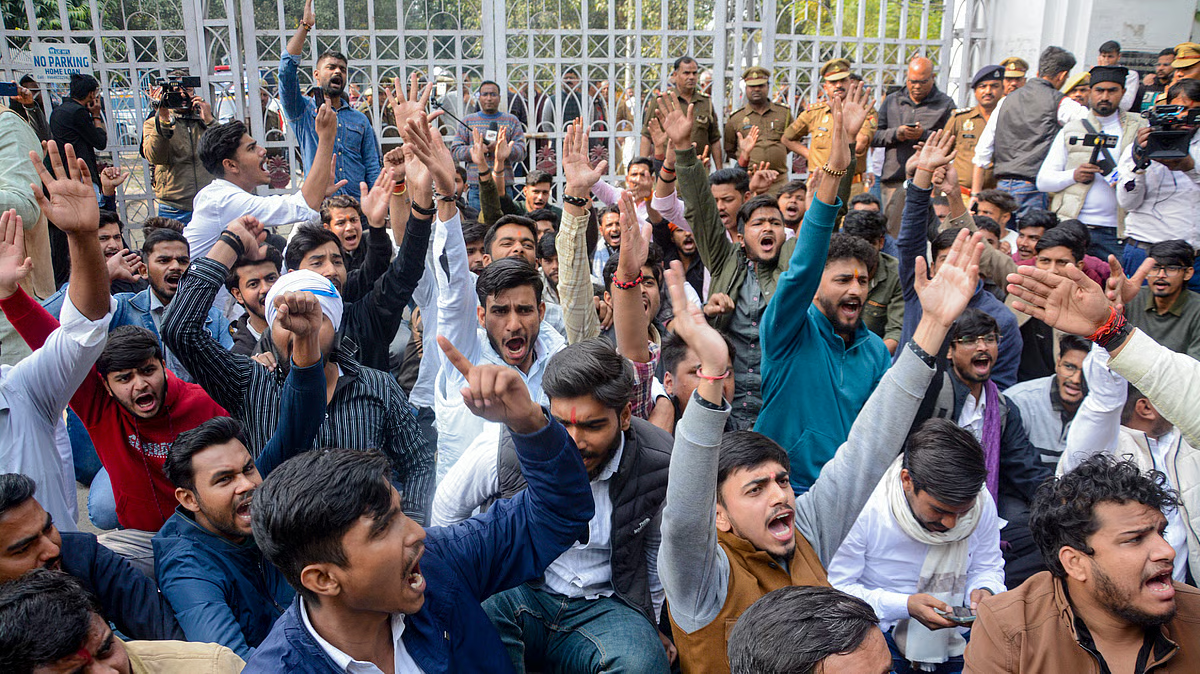
The Union government has firmly defended the newly notified UGC Promotion of Equity in Higher Education Institutions Regulations, 2026, stating that the rules will neither be discriminatory nor open to misuse—despite growing protests, political resignations, and a legal challenge in the Supreme Court.
The regulations, aimed at strengthening safeguards against caste-based discrimination in higher education, have triggered intense debate across university campuses and political circles.
What Has Triggered the Controversy?
The 2026 regulations significantly expand the scope of the earlier UGC Equity Regulations, 2012, which were largely advisory. The new framework:
- Brings Other Backward Classes (OBCs) under formal protection, alongside Scheduled Castes (SCs) and Scheduled Tribes (STs)
- Makes it mandatory for all higher education institutions to form Equity Committees
- Requires representation of SCs, STs, OBCs, women, and persons with disabilities in these committees
The rules were officially notified on 13 January 2026.
Government’s Stand: “No Discrimination, No Harassment”
Amid protests by students in several states, Union Education Minister Dharmendra Pradhan reassured stakeholders that the regulations would be implemented strictly within constitutional boundaries.
“No one is going to face harassment. There will be no discrimination, and no one will have the right to misuse these regulations in the name of equity,” the minister said.
He added that both central and state authorities share responsibility for ensuring fair and lawful implementation.
Political Fallout and Administrative Action
The regulations have already led to political resignations. In Uttar Pradesh, a BJP Mahila Morcha office bearer resigned, stating she did not support the new equity framework.
Separately, PCS officer Alankar Agnihotri resigned from service citing opposition to the UGC regulations and an unrelated administrative incident at the Prayagraj Magh Mela. He was later suspended by the Uttar Pradesh government on grounds of indiscipline and attached to the Shamli District Magistrate’s office.
Student Groups and Mixed Reactions
Left-backed student organisation All India Students’ Association (AISA) welcomed the inclusion of OBCs under the equity framework but raised serious concerns.
In a statement, AISA said:
- Representation norms in Equity Committees are vague and inadequately defined
- The definition of discrimination is too broad and abstract
- Clear examples and enforceable safeguards are missing
Matter Reaches the Supreme Court
A petition has been filed in the Supreme Court challenging the regulations, alleging that the UGC has adopted a non-inclusive and constitutionally flawed definition of caste-based discrimination.
The plea seeks:
- A stay on enforcement of the regulations in their current form
- A redefinition of discrimination that is caste-neutral and constitutionally compliant
The regulations were drafted after the Supreme Court sought updated guidelines during hearings related to the deaths of Rohith Vemula (2016) and Payal Tadvi (2019)—both cases involving alleged caste-based harassment in academic institutions.
Interesting Read
Why This Matters to Students and Institutions
The new UGC Equity Regulations mark a major shift from advisory guidelines to mandatory institutional mechanisms. While the intent is to create safer, more inclusive campuses, critics warn that unclear definitions and implementation gaps could lead to confusion or misuse.
As the issue unfolds in courts, campuses, and policymaking circles, the regulations are set to play a crucial role in shaping the future of equity and accountability in India’s higher education system.